Dialectica Open the atlas

Greece & Rome · 384–322 BCE

Aristotle

Plato’s student, Alexander’s tutor, founder of the Lyceum
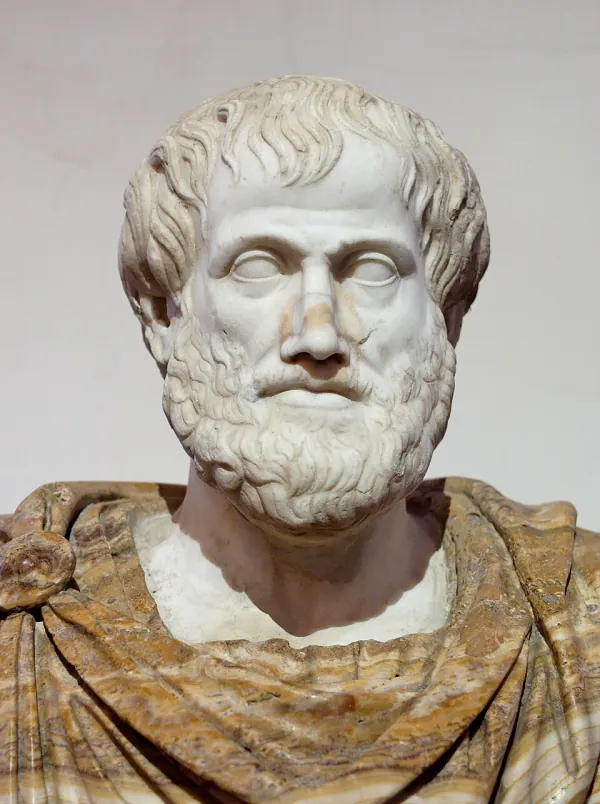
Aristotle
After Lysippos · Public domain · Commons ↗

Brought Plato’s Forms down into things and founded formal logic, biology and the systematic study of ethics and politics. He held that humans are rational, political animals whose good is a life of virtuous activity.

Life and thought

Aristotle was born in 384 BCE in Stagira, in northern Greece, the son of a court doctor to the Macedonian king. At seventeen he joined Plato’s Academy and stayed twenty years. After Plato’s death he did research on Lesbos, especially in marine biology, and tutored the young Alexander the Great. In 335 he founded the Lyceum in Athens; after Alexander’s death, anti-Macedonian feeling drove him to Chalcis, where he died in 322. His surviving works are mostly lecture treatises; his polished dialogues are lost.

He kept Plato’s demand that knowledge be of what is universal but placed forms in things: a horse’s form is its structure and way of life, not a separate Form elsewhere. To understand anything, ask four questions: what is it made of, what is its form, what produced it, and what is it for. He invented formal logic with the syllogism, founded zoology, and argued that human happiness is a life of activity in accordance with virtue within a political community. For medieval Islamic, Jewish and Christian thinkers he was simply “the Philosopher”.

Works

c. 340 BCENicomachean Ethics
c. 330 BCEMetaphysics
c. 330 BCEPolitics

Teachers

c. 428–348 BCEPlatoSocrates’ student, founder of the Academy, master of the dialogue

Students

c. 371–287 BCETheophrastusAristotle’s successor at the Lyceum and founder of botany

Shaped

c. 204–270PlotinusFounder of Neoplatonism, teaching in Romec. 234–305PorphyryPlotinus’ student, editor and biographerc. 477–524 or 526BoethiusRoman statesman who translated Aristotle’s logic into Latin1079–1142Peter AbelardParis logician famed for his dialectic and his love for Héloïse1225–1274Thomas AquinasDominican friar who wove Aristotle into Christian theologyc. 1287–1347William of OckhamEnglish Franciscan logician who defied the popec. 1300–c. 1360Jean BuridanParis arts master, logician and natural philosopherc. 1240–c. 1284 (born 1235–40, died 1281–84)Siger of BrabantRadical Aristotelian master at the Paris arts faculty1138–1204Maimonides (Moses ben Maimon)Rabbi, physician and philosopher from Córdoba, later in Cairoc. 801–873Al-KindīBaghdad polymath called “the philosopher of the Arabs”c. 870–950Al-FārābīLogician called the “Second Teacher” after Aristotle980–1037Ibn Sīnā (Avicenna)Persian physician-philosopher, the most influential Islamic philosopher1126–1198Ibn Rushd (Averroes)Córdoban judge, known in Europe simply as “the Commentator”1889–1976Martin HeideggerGerman philosopher of Being, compromised by his Nazi party membership1900–2002Hans-Georg GadamerGadamer modelled understanding on Aristotle’s practical wisdom (phronesis).1911–1960J. L. AustinOxford philosopher of language who founded speech-act theoryborn 1947Martha NussbaumChicago philosopher of the capabilities approach and the emotions1919–2001G. E. M. AnscombeWittgenstein’s student and translator who relaunched virtue ethics1920–2010Philippa FootOxford moral philosopher who devised the trolley problem1929–2025Alasdair MacIntyreScottish-born philosopher who moved from Marxism to Thomism

Criticised by

1561–1626Francis BaconBacon’s Novum Organum set out to replace Aristotle’s Organon and its reliance on syllogism.

Meanwhile, in other traditions

c. 390–338 BCEShang YangQin minister whose reforms built Qin’s powerc. 372–289 BCEMenciusConfucian who argued that human nature is goodc. 370–310 BCEHui ShiWei statesman, logician and Zhuangzi’s debating partnerc. 369–286 BCEZhuangziDaoist writer of parables, paradoxes and freedom