Dialectica Open the atlas

The Islamic world · 1126–1198

Ibn Rushd (Averroes)

Córdoban judge, known in Europe simply as “the Commentator”
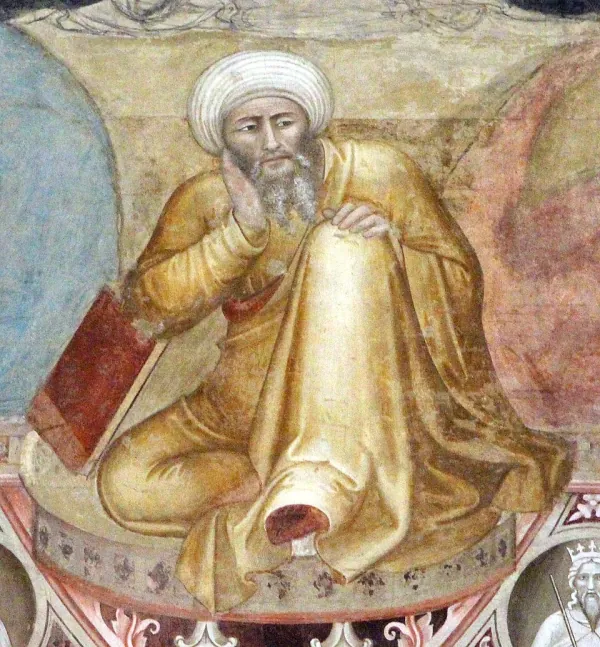
Ibn Rushd (Averroes)
Sailko · CC BY 3.0 · Commons ↗

The Qur’an itself commands philosophical study, and where demonstration conflicts with the literal text, the text must be interpreted. He defended Aristotle against al-Ghazālī and against Avicenna’s Neoplatonic additions.

Life and thought

Ibn Rushd, Averroes in Latin, was born in Córdoba in 1126 into a family of leading jurists. He became a judge in Seville and chief judge of Córdoba, and court physician in Marrakesh, after Ibn Ṭufayl introduced him to the Almohad caliph, who asked him to explain Aristotle clearly. Late in life he fell out of favour, was briefly exiled and his books were burned; he was soon pardoned and died in Marrakesh in 1198.

He wrote commentaries on almost all of Aristotle, short, middle and long, which made him simply “the Commentator” in Latin Europe. In The Decisive Treatise he argued, as a jurist, that the Qur’an itself commands rational reflection on creation, so philosophy is obligatory for those capable of it; where a demonstration conflicts with the literal text, the text must be interpreted. The Incoherence of the Incoherence answers al-Ghazālī point by point. His view that the material intellect is one for all humans became the centre of the “Averroist” controversy in Paris.

Works

c. 1179The Decisive Treatise
c. 1180The Incoherence of the Incoherence
c. 1190Long Commentary on Aristotle’s On the Soul

Shaped by

384–322 BCEAristotlePlato’s student, Alexander’s tutor, founder of the Lyceumc. 1105–1185Ibn ṬufaylIbn Ṭufayl introduced the young Ibn Rushd to the Almohad caliph, who asked for clear commentaries on Aristotle.

Shaped

1225–1274Thomas AquinasDominican friar who wove Aristotle into Christian theologyc. 1240–c. 1284 (born 1235–40, died 1281–84)Siger of BrabantRadical Aristotelian master at the Paris arts faculty

Argued against

c. 1058–1111Al-GhazālīThe Incoherence of the Incoherence answers al-Ghazālī point by point.980–1037Ibn Sīnā (Avicenna)Averroes faulted Avicenna for compromising Aristotle with theology, for example in treating existence as an accident of essence.

Meanwhile, in other traditions

c. 1077–1157 (traditionally 1017–1137)RāmānujaVaiṣṇava theologian and founder of Viśiṣṭādvaita1079–1142Peter AbelardParis logician famed for his dialectic and his love for Héloïse1130–1200Zhu XiGreat synthesiser of Song Neo-Confucianism1138–1204Maimonides (Moses ben Maimon)Rabbi, physician and philosopher from Córdoba, later in Cairo1139–1193Lu Jiuyuan (Lu Xiangshan)Song scholar who taught that the mind is principle