Dialectica Open the atlas

Medieval Europe · 1225–1274

Thomas Aquinas

Dominican friar who wove Aristotle into Christian theology
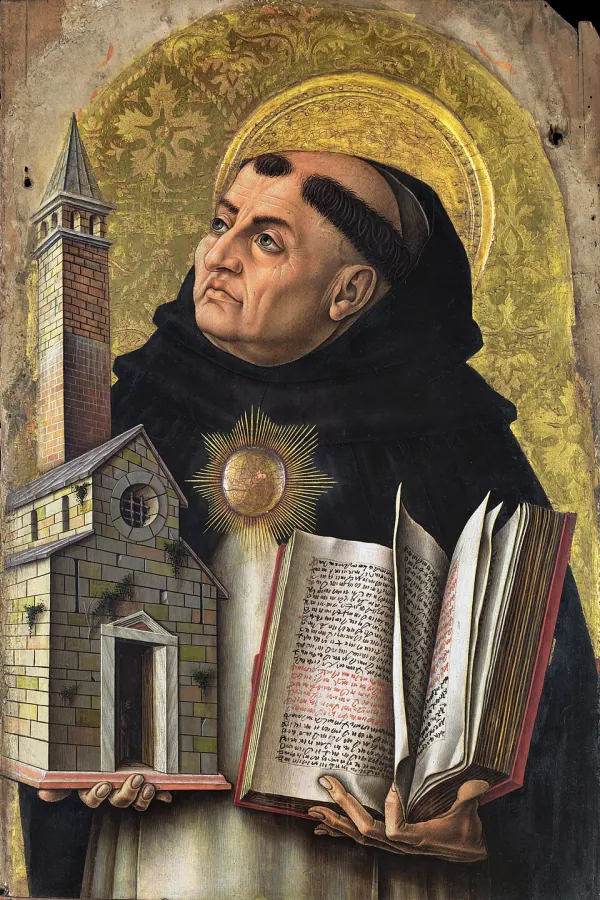
Thomas Aquinas
Carlo Crivelli · Public domain · Commons ↗

Reason and faith are two roads to one truth: reason can prove that God exists, through the “five ways”, while revelation adds what reason cannot reach. In every creature, its essence is distinct from its act of existing; only in God are they one.

Life and thought

Thomas Aquinas was born in 1225 at Roccasecca, south of Rome, to a noble family that expected him to become abbot of Monte Cassino. Instead he joined the new Dominican order of begging friars; his brothers held him captive for about a year, but he persisted, studied under Albert the Great in Paris and Cologne, and taught in Paris, Naples and Italian priories. In December 1273 he stopped writing, saying that all he had written seemed like straw, and he died in 1274.

Aquinas built a synthesis in which reason and revelation are two routes to one truth. Reason, working from what the senses show, as Aristotle taught, can prove that God exists: things move and are caused, the chain cannot run back forever, so there is a first mover and first cause, the “five ways”. Revelation adds what reason cannot reach. In every creature what it is differs from the fact that it is; only in God are essence and existence the same. Partly condemned in 1277 and canonised in 1323, he later became the Catholic Church’s official philosopher.

Works

c. 1255On Being and Essence
c. 1265Summa contra Gentiles
c. 1273Summa Theologiae

Shaped by

384–322 BCEAristotlePlato’s student, Alexander’s tutor, founder of the Lyceum354–430Augustine of HippoNorth African bishop who fused Christianity with Platonism980–1037Ibn Sīnā (Avicenna)Persian physician-philosopher, the most influential Islamic philosopher1126–1198Ibn Rushd (Averroes)Córdoban judge, known in Europe simply as “the Commentator”1138–1204Maimonides (Moses ben Maimon)Rabbi, physician and philosopher from Córdoba, later in Cairoc. 477–524 or 526BoethiusRoman statesman who translated Aristotle’s logic into Latin

Shaped

1919–2001G. E. M. AnscombeWittgenstein’s student and translator who relaunched virtue ethics1920–2010Philippa FootOxford moral philosopher who devised the trolley problem1929–2025Alasdair MacIntyreScottish-born philosopher who moved from Marxism to Thomism

Argued against

1033–1109Anselm of CanterburyAquinas denied that God’s existence is self-evident and rejected Anselm’s ontological argument.c. 1240–c. 1284 (born 1235–40, died 1281–84)Siger of BrabantAquinas wrote On the Unity of the Intellect (1270) against Siger and the Paris Averroists.

Criticised by

c. 1266–1308John Duns ScotusScotus replaced Aquinas’s analogy of being with the univocity of being.

Meanwhile, in other traditions

1165–1240Ibn ʿArabīAndalusian mystic, called “the Greatest Master” by followers1200–1253DōgenJapanese monk who founded Sōtō Zen1207–1273Jalāl al-Dīn RūmīPersian poet and Sufi teacher in Konya1238–1317 (some sources: 1199–1278)MadhvaFounder of Dvaita, the dualist school of Vedānta