Medieval Europe · 354–430
Augustine of Hippo
North African bishop who fused Christianity with Platonism
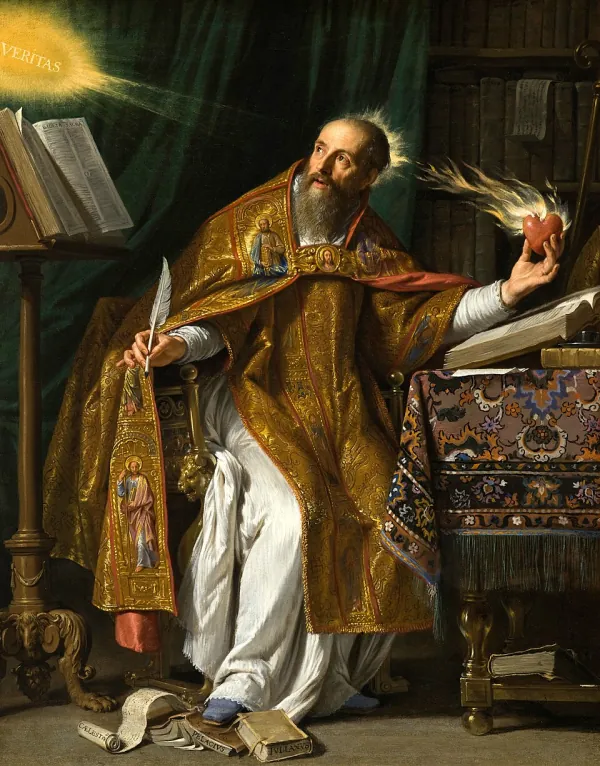
Evil is a privation of good, freely chosen by a will turned away from God; we find truth by turning inward, where God illuminates the mind.
Life and thought
Augustine was born in 354 in Thagaste, in Roman North Africa, to a pagan father and a Christian mother, Monica. He taught rhetoric in Carthage, Rome and Milan, spent nine years among the Manichaeans, and passed through scepticism before reading Neoplatonist books and hearing Bishop Ambrose. After his conversion in 386 he returned to Africa, became bishop of Hippo in about 395 and died in 430 as the Vandals besieged the city.
His Confessions tell this search from the inside. Two ideas from it shaped the West. Evil is not a substance competing with God, as the Manichaeans held, but a lack of good: a will that turns from the highest good to lesser ones. And truth is found by turning inward: certain truths, like those of number, cannot come from the changing senses, so God must illuminate the mind. The City of God, written after the sack of Rome in 410, read all history as two loves at war.
Works
Shaped by
c. 204–270PlotinusFounder of Neoplatonism, teaching in Rome106–43 BCECiceroReading Cicero’s lost Hortensius at nineteen turned Augustine to philosophy; he later wrote Against the Academicians to refute Ciceronian scepticism.Shaped
c. 477–524 or 526BoethiusRoman statesman who translated Aristotle’s logic into Latin1033–1109Anselm of CanterburyBenedictine monk and Archbishop of Canterbury1225–1274Thomas AquinasDominican friar who wove Aristotle into Christian theology1596–1650René DescartesArnauld pointed out that Augustine had already argued “if I am mistaken, I exist”; how far Descartes drew on him is debated.1906–1975Hannah ArendtHer doctoral dissertation (1929) was on the concept of love in Augustine.1913–2005Paul RicœurTime and Narrative starts from Augustine’s puzzles about time in Confessions XI.Criticised by
1889–1951Ludwig WittgensteinPhilosophical Investigations opens by quoting Augustine’s picture of learning words by naming objects, and then dismantles it.Meanwhile, in other traditions
c. 4th–5th c. CEVasubandhuAbhidharma master who became Yogācāra’s great systematiserc. 2nd–5th c. CE (dates uncertain)UmāsvātiAuthor of the Jain text accepted by both main sectsc. 4th–5th c. CEĪśvarakṛṣṇaAuthor of the classical summary of Sāṃkhyac. 4th–5th c. CE? (dating disputed)PatañjaliCompiler of the Yoga Sūtraborn c. 350–370; died 415HypatiaMathematician and Neoplatonist teacher in Alexandriafl. 5th c. CEBuddhaghosaTheravāda commentator who systematised doctrine in Sri LankaOn the record
Descartes drew on Augustine’s “if I am mistaken, I exist”; how far is debated.
Arnauld’s Fourth Objections (1641) cited Augustine’s On Free Choice 2.3 as a source of the cogito, and in 1640 Colvius pointed Descartes to City of God 11.26; Descartes thanked them but acknowledged no debt and stressed his different use of the argument. Recent scholarship, notably Stephen Menn’s Descartes and Augustine (1998), argues the debt was extensive. The tie is kept as influence, with the dispute stated.
Sources: The Cambridge Descartes Lexicon, “Augustine, Aurelius”