Early modern Europe · 1596–1650
René Descartes
French mathematician who rebuilt philosophy on the certainty of thought
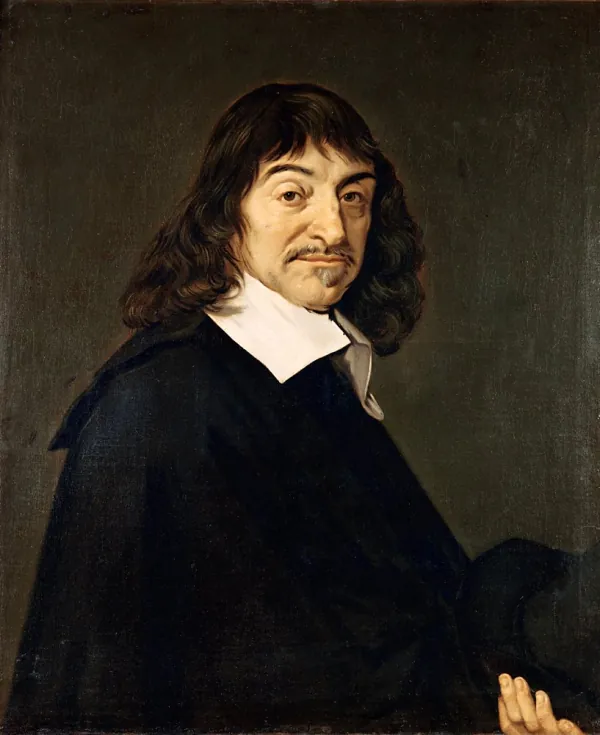
Doubting everything that could be doubted, he found one certainty: “I think, therefore I am.” He held that mind and body are two distinct substances, opening the modern mind–body problem.
Life and thought
René Descartes was educated by the Jesuits at La Flèche and took a law degree at Poitiers. As a young gentleman soldier he had, on the night of 10 November 1619, a series of dreams that he took as a call to rebuild knowledge. He spent most of his working life in the Dutch Republic, writing on optics, physics, physiology and geometry, where he joined algebra to geometry through coordinates. Invited by Queen Christina, he moved to Stockholm in 1649 and died there in February 1650.
The Meditations (1641) begin by doubting everything that can be doubted: the senses, the existence of his body, even mathematics, in case an all-powerful demon is deceiving him. One thing survives: while he doubts, he thinks, and so he exists. From this he argues to a God who is no deceiver, and so to the reliability of what he perceives clearly and distinctly. Mind, whose essence is thinking, turns out to be a substance distinct from body, whose essence is extension. That split gave modern philosophy its mind–body problem, and his method made certainty the goal of knowledge.
Works
Shaped by
1533–1592Michel de MontaigneFrench magistrate who invented the essay as self-examination354–430Augustine of HippoArnauld pointed out that Augustine had already argued “if I am mistaken, I exist”; how far Descartes drew on him is debated.Shaped
1632–1677Baruch SpinozaThe only book Spinoza published under his own name was an exposition of Descartes’ Principles (1663).1632–1704John LockeLocke reportedly said Descartes first gave him a relish for philosophy, freeing him from the obscure way of the schools.1905–1980Jean-Paul SartreSartre took the Cartesian cogito as his starting point.1859–1938Edmund HusserlHusserl presented phenomenology as a renewed Cartesian Meditations.1906–1995Emmanuel LevinasHe took Descartes’s idea of the infinite as a model for the other who exceeds my grasp.Criticised by
1646–1716Gottfried Wilhelm LeibnizLeibniz argued that Descartes was wrong about what is conserved in motion and that extension cannot be the essence of matter.1588–1679Thomas HobbesHobbes wrote the third set of Objections to Descartes’ Meditations (1641), rejecting an immaterial mind.1908–1961Maurice Merleau-PontyHe rejected the Cartesian split between mind and body.1931–2007Richard RortyPhilosophy and the Mirror of Nature traces the idea of the mind as an inner mirror back to Descartes, and rejects it.1900–1976Gilbert RyleThe Concept of Mind attacks Descartes’s dualism as “the dogma of the Ghost in the Machine”.Meanwhile, in other traditions
c. 1571–1636Mullā ṢadrāSafavid philosopher of Shiraz, founder of Transcendent TheosophyOn the record
Descartes drew on Augustine’s “if I am mistaken, I exist”; how far is debated.
Arnauld’s Fourth Objections (1641) cited Augustine’s On Free Choice 2.3 as a source of the cogito, and in 1640 Colvius pointed Descartes to City of God 11.26; Descartes thanked them but acknowledged no debt and stressed his different use of the argument. Recent scholarship, notably Stephen Menn’s Descartes and Augustine (1998), argues the debt was extensive. The tie is kept as influence, with the dispute stated.
Sources: The Cambridge Descartes Lexicon, “Augustine, Aurelius”
Locke reportedly said Descartes first gave him a relish for philosophy.
The report goes back to Lady Damaris Masham, in whose house Locke spent his last years: her memoir of him, sent to Jean Le Clerc, is the source of Le Clerc’s 1705 Éloge and of the first printed lives, which state that the first books that gave Locke a relish for philosophy were those of Descartes. It is second-hand, but early and close.
Sources: Stanford Encyclopedia of Philosophy, “Lady Damaris Masham” · Encyclopaedia Britannica, 3rd ed. (1797), “Locke”