Early modern Europe · 1632–1704
John Locke
English physician and philosopher of experience, consent and toleration
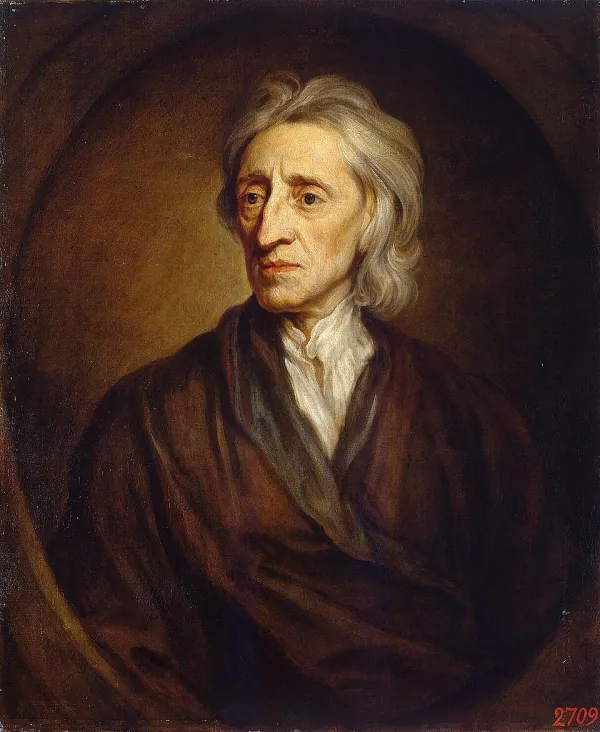
The mind begins as “white paper” written on by experience. Governments exist to protect life, liberty and property, rest on the consent of the governed, and may be resisted when they betray that trust.
Life and thought
John Locke studied at Oxford, trained as a physician and became doctor and adviser to the Earl of Shaftesbury, leader of the opposition to the Catholic heir, James. Under suspicion after Shaftesbury’s fall, Locke fled to the Netherlands in 1683 and returned after the Glorious Revolution of 1688. In 1689 he published, in quick succession, the Essay Concerning Human Understanding (its title page dated 1690), the Two Treatises of Government and the Letter Concerning Toleration.
The Essay asks where our ideas come from. Against innate ideas, Locke argues that the mind begins like white paper and receives all its materials from sensation and reflection; even ideas such as substance or infinity are built from them. Knowledge is therefore limited, and belief should be proportioned to evidence. In politics, people in the state of nature already have rights to life, liberty and property; they set up government by consent to protect those rights, and may resist a government that violates them. Toleration follows from the limits of knowledge and the purpose of the state. These ideas ran through the Enlightenment and into the American Declaration of Independence.
Works
Shaped by
1596–1650René DescartesLocke reportedly said Descartes first gave him a relish for philosophy, freeing him from the obscure way of the schools.Shaped
1711–1776David HumeScottish skeptic who traced knowledge and morals to experience and feeling1712–1778Jean-Jacques RousseauGeneva-born writer who blamed society, not nature, for human corruption1689–1755MontesquieuFrench magistrate who compared the laws of many nations1694–1778VoltaireFrench writer who campaigned against intolerance and fanaticism1759–1797Mary WollstonecraftEnglish writer who argued that women are rational beings owed education1921–2002John RawlsHarvard philosopher who revived political philosophy with justice as fairness1938–2002Robert NozickHarvard libertarian who answered RawlsCriticised by
1646–1716Gottfried Wilhelm LeibnizLeibniz’s New Essays answer Locke’s Essay chapter by chapter in defence of innate ideas.1685–1753George BerkeleyBerkeley attacked Locke’s abstract ideas and his material substance that no one can perceive.Meanwhile, in other traditions
c. 1571–1636Mullā ṢadrāSafavid philosopher of Shiraz, founder of Transcendent TheosophyOn the record
The Essay Concerning Human Understanding and the Two Treatises are dated 1689.
Both came out in late 1689 (the Essay in December) but carry 1690 on their title pages, so both years appear in references. The English Letter Concerning Toleration also appeared in 1689, after a Latin original printed in Holland the same year.
Sources: Stanford Encyclopedia of Philosophy, “John Locke” · Wikisource, title page of the 1690 first edition of the Essay
Locke reportedly said Descartes first gave him a relish for philosophy.
The report goes back to Lady Damaris Masham, in whose house Locke spent his last years: her memoir of him, sent to Jean Le Clerc, is the source of Le Clerc’s 1705 Éloge and of the first printed lives, which state that the first books that gave Locke a relish for philosophy were those of Descartes. It is second-hand, but early and close.
Sources: Stanford Encyclopedia of Philosophy, “Lady Damaris Masham” · Encyclopaedia Britannica, 3rd ed. (1797), “Locke”