Early modern Europe · 1711–1776
David Hume
Scottish skeptic who traced knowledge and morals to experience and feeling
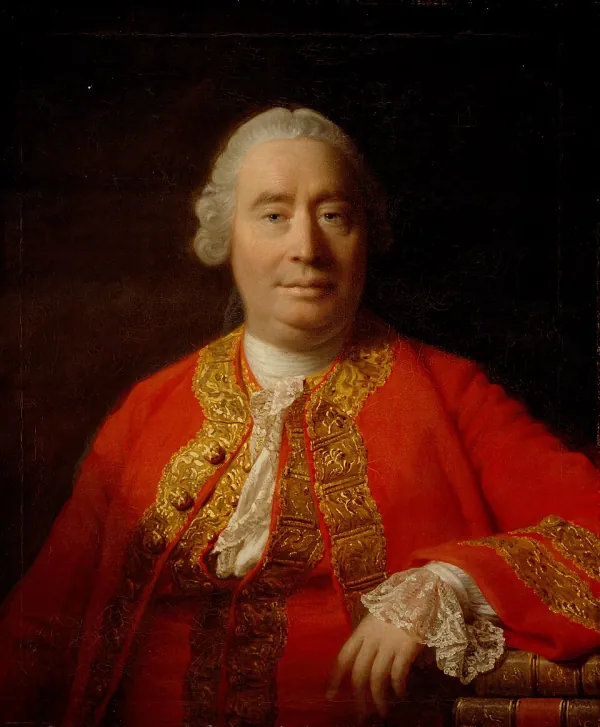
We never observe necessary connections, only constant conjunctions, so belief in causes is a habit of the mind. Reason alone cannot move us to act — “reason is, and ought only to be the slave of the passions” — and morality rests on sentiment.
Life and thought
David Hume grew up near Edinburgh and studied at its university. After a breakdown in his early twenties he went to France, where at La Flèche he wrote A Treatise of Human Nature (1739–40), which, he said, “fell dead-born from the press”. Twice refused a professorship because of his reputation for irreligion, he became famous instead as an essayist and as the author of a bestselling History of England, and served as a diplomat in Paris. His Dialogues Concerning Natural Religion were published only after his death in 1776.
Hume applied the experimental method to the mind. All our ideas copy impressions, so what is our idea of a cause? We see one billiard ball strike another and the second move, but we never perceive a necessary connection — only constant conjunction, after which the mind, by habit, expects the effect. Our trust in induction rests on custom, not on reason. Morality too rests on feeling: reason tells us facts, but only passion moves us to act, and no “ought” follows from an “is” alone. His skepticism woke Kant and shaped utilitarianism and modern naturalism.