Early modern Europe · 1724–1804
Immanuel Kant
Königsberg professor whose critical philosophy redrew modern thought
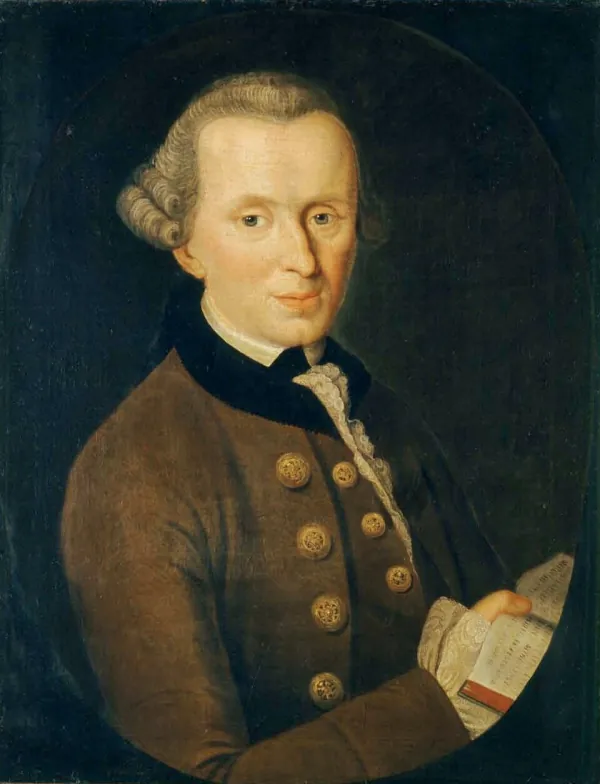
The mind actively structures experience, so we can know appearances with certainty but never things in themselves. Morality is a law reason gives itself: act only on a maxim you could will to be a universal law.
Life and thought
Immanuel Kant spent his whole life in and around Königsberg in East Prussia, the son of a Pietist harness-maker. For decades he lectured at its university on everything from physics and logic to geography and anthropology. After a long “silent decade” he published the Critique of Pure Reason in 1781, at fifty-seven, and over the next ten years the works that reshaped ethics, aesthetics and political thought.
Kant’s “Copernican revolution” reverses the usual picture: instead of the mind conforming to objects, objects as we experience them must conform to the mind’s forms — space, time and categories such as cause and effect. That explains how we can know some things a priori, such as that every event has a cause, but it limits knowledge to appearances: God, freedom and the immortal soul lie beyond proof, though not beyond rational faith. In ethics, the moral law comes neither from God nor from the pursuit of happiness but from reason itself: act only on a maxim you could will as a universal law, and treat humanity never merely as a means. Almost every later school defines itself by how it answers him.
Works
Shaped by
1646–1716Gottfried Wilhelm LeibnizGerman polymath, co-inventor of calculus, theorist of monads1711–1776David HumeKant credited Hume with waking him from his “dogmatic slumber”.1712–1778Jean-Jacques RousseauKant wrote that Rousseau “set me right” and taught him to honour human beings.Shaped
1762–1814Johann Gottlieb FichteFichte’s first book (1792), published anonymously, was at first taken to be Kant’s own.1770–1831Georg Wilhelm Friedrich HegelGerman philosopher of spirit, history and dialectic1788–1860Arthur SchopenhauerGerman pessimist who saw a blind will behind all things1859–1938Edmund HusserlMoravian-born mathematician turned philosopher, founder of phenomenology1906–1975Hannah ArendtShe found a model for political judgement in Kant’s Critique of Judgement.1768–1834Friedrich SchleiermacherBerlin theologian and translator of Plato, father of modern hermeneutics1833–1911Wilhelm DiltheyHe sought a “critique of historical reason” to complement Kant’s critiques.1895–1973Max HorkheimerDirector of the Frankfurt Institute who defined critical theory1929–2026Jürgen HabermasLeading second-generation Frankfurt theorist of democracy and communication1924–1998Jean-François LyotardHe revived Kant’s idea of the sublime for art and politics.1839–1914Charles Sanders PeirceFrom 1855, his first year at Harvard, Peirce spent about three years in intense study of the Critique of Pure Reason, and kept rereading it all his life.1902–1994Karl PopperViennese-born philosopher of science and defender of the open society1921–2002John RawlsHarvard philosopher who revived political philosophy with justice as fairness1938–2002Robert NozickHarvard libertarian who answered Rawls1909–1995Mou ZongsanMou translated Kant and argued against his denial of intellectual intuition to human beings.Criticised by
1806–1873John Stuart MillMill’s Utilitarianism argues that Kant’s universal law, applied, only shows that some rules would have bad consequences.1848–1925Gottlob FregeFrege argued, against Kant, that arithmetic is analytic, though he agreed with Kant that geometry is synthetic a priori.1919–2001G. E. M. Anscombe“Modern Moral Philosophy” calls Kant’s idea of legislating for oneself absurd.Meanwhile, in other traditions
1768–1834Friedrich SchleiermacherBerlin theologian and translator of Plato, father of modern hermeneuticsOn the record
The note said Peirce studied the Critique of Pure Reason for hours every day for more than three years.
The Stanford Encyclopedia confirms that Peirce began Kant in 1855, his first year at Harvard, spent about three years in intense study of the Critique, and kept rereading it all his life, though he came to judge its logic flawed. The exact daily-hours wording could not be checked in a source, so the note now states what is documented.
Sources: Stanford Encyclopedia of Philosophy, “Charles Sanders Peirce”