Early modern Europe · 1770–1831
Georg Wilhelm Friedrich Hegel
German philosopher of spirit, history and dialectic
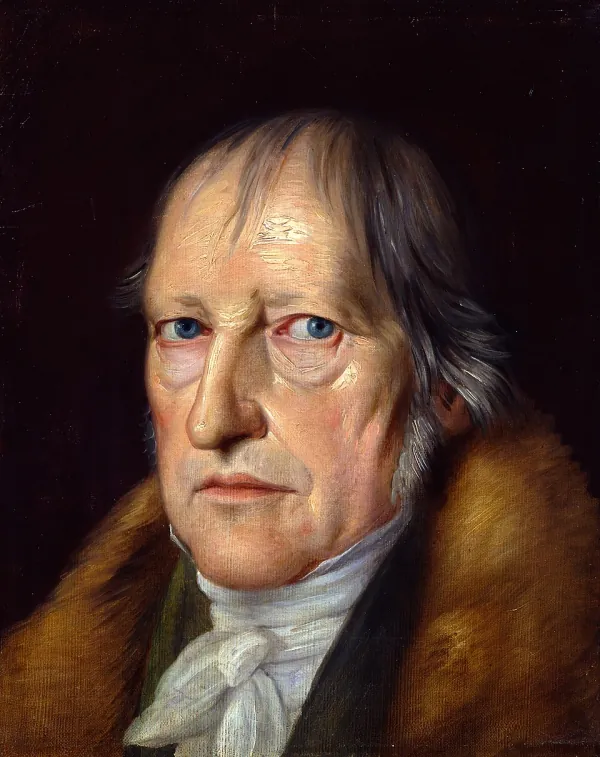
Reality is spirit coming to know itself through a dialectical process in which every limited position produces its own contradiction and is overcome. World history is the progress of the consciousness of freedom.
Life and thought
Georg Wilhelm Friedrich Hegel studied at the Tübingen seminary with Schelling and Hölderlin and worked for years as a private tutor. He finished the Phenomenology of Spirit at Jena in 1806 as Napoleon’s army fought outside the town. He then edited a newspaper in Bamberg and ran a school in Nuremberg, before professorships at Heidelberg and, from 1818, Berlin, where he became the most influential philosopher in Germany. He died in 1831, probably of cholera.
Hegel’s guiding claim is that “the true is the whole”. Any limited idea or way of life, followed to its consequences, runs into contradictions that force it to be taken up into a richer one; he called this movement dialectic. The Phenomenology follows consciousness through such stages, including the struggle between master and slave, until spirit comes to understand itself. History too is the story of freedom becoming conscious: in the ancient East one was free, in Greece and Rome some, in the modern world all. His followers split into conservatives and radicals, and Marx, Kierkegaard and the pragmatists all began by arguing with him.
Works
Shaped by
1775–1854Friedrich Wilhelm Joseph SchellingHegel and Schelling edited the Critical Journal of Philosophy together in 1802–03.1724–1804Immanuel KantKönigsberg professor whose critical philosophy redrew modern thought1632–1677Baruch SpinozaDutch lens-grinder, expelled by his synagogue, who equated God with NatureShaped
1818–1883Karl MarxMarx kept Hegel’s dialectic but replaced the movement of Spirit with material production.1820–1895Friedrich EngelsManufacturer’s son who co-founded Marxism with Marx1908–1986Simone de BeauvoirThe Second Sex uses Hegel’s master–slave dialectic to analyse woman as the Other.1903–1969Theodor W. AdornoFrankfurt philosopher, music theorist and critic of the culture industry1898–1979Herbert MarcuseFrankfurt School exile who became the New Left’s philosopher1925–1961Frantz FanonBlack Skin, White Masks reworks Hegel’s master–slave dialectic for colonial racism.1859–1952John DeweyDewey said Hegel left “a permanent deposit” in his thinking.1870–1945Nishida KitarōFounder of the Kyoto SchoolArgued against
1762–1814Johann Gottlieb FichteHegel’s 1801 essay on the difference between Fichte’s and Schelling’s systems judged Fichte’s one-sidedly subjective.Criticised by
1775–1854Friedrich Wilhelm Joseph SchellingOnce Tübingen roommates, they drifted apart after 1807; in 1841 Schelling was called to Berlin to counter Hegel’s legacy.1788–1860Arthur SchopenhauerHe scheduled his Berlin lectures at the same hour as Hegel’s and called him a charlatan.1813–1855Søren KierkegaardKierkegaard mocked Hegel’s system for forgetting the single existing individual.1925–1995Gilles DeleuzeDeleuze built a philosophy of difference explicitly against Hegel’s dialectic.1872–1970Bertrand RussellLogician, public intellectual and Nobel laureate; lectured in China 1920–211902–1994Karl PopperViennese-born philosopher of science and defender of the open societyMeanwhile, in other traditions
1768–1834Friedrich SchleiermacherBerlin theologian and translator of Plato, father of modern hermeneutics1813–1855Søren KierkegaardDanish Christian thinker of the anxious, choosing individual1818–1883Karl MarxGerman philosopher, economist and revolutionary in London exile1820–1895Friedrich EngelsManufacturer’s son who co-founded Marxism with MarxOn the record
Schopenhauer scheduled his Berlin lectures at the same hour as Hegel’s.
In March 1820 Schopenhauer, newly licensed to teach in Berlin, scheduled his class at the same time as Hegel’s popular lectures; few students came. He had studied in Berlin in 1811–13, where his lecturers included Fichte.
Sources: Stanford Encyclopedia of Philosophy, “Arthur Schopenhauer”