Analytic & pragmatist · 1859–1952
John Dewey
Philosopher of education and democracy; lectured in China 1919–21
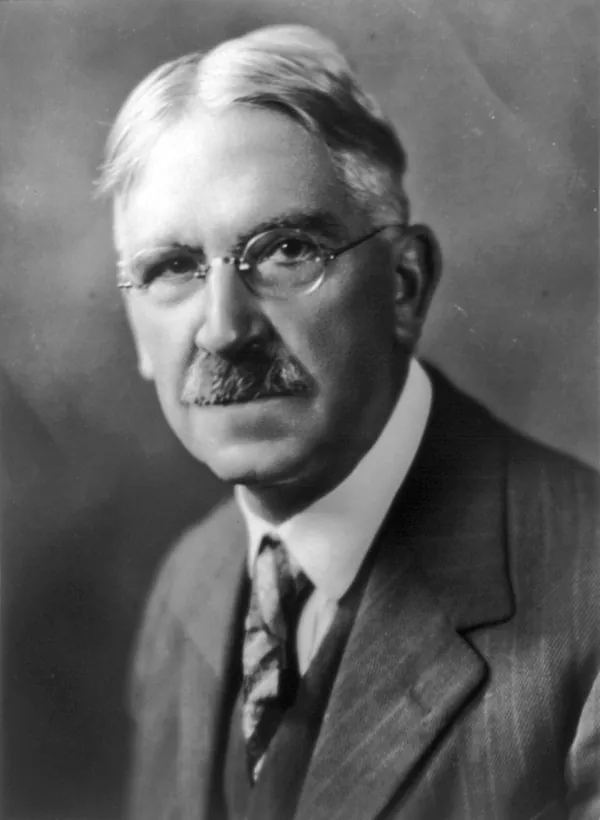
Thinking is a tool for solving real problems, and democracy is not just a voting system but a way of life built on shared, experimental inquiry; schools should teach by doing.
Life and thought
John Dewey (1859–1952) was born in Burlington, Vermont, and took his doctorate at Johns Hopkins in 1884, where George Sylvester Morris drew him to Hegel. At the University of Chicago he founded a Laboratory School (1896) to test his ideas about teaching; from 1904 he taught at Columbia. For half a century a public intellectual, he lectured in Japan and for over two years in China (1919–21), was the first president of the American Association of University Professors, and in 1937 chaired the commission that examined Moscow’s charges against Trotsky.
Dewey treated thinking as the way living creatures cope with their surroundings (“instrumentalism”): inquiry begins in a troubled situation and ends when action resolves it, and ideas are hypotheses to be tested in practice. Schools should therefore teach through doing and shared projects rather than rote learning, and democracy is a way of life built on cooperative, experimental problem-solving, not just a voting system. His Columbia students included Hu Shi and B. R. Ambedkar, who carried his ideas to China and India.
Works
Shaped by
1770–1831Georg Wilhelm Friedrich HegelDewey said Hegel left “a permanent deposit” in his thinking.1839–1914Charles Sanders PeirceDewey took Peirce’s logic course as a graduate student at Johns Hopkins, and later built on his theory of inquiry.1842–1910William JamesPsychologist and philosopher who made pragmatism famousStudents
1891–1956B. R. AmbedkarAmbedkar studied under John Dewey at Columbia University (1913–16) and drew on his ideas of democracy.1891–1962Hu ShiHu Shi studied with Dewey at Columbia and interpreted for him during his lecture tour of China in 1919–21.Shaped
1931–2007Richard RortyRorty named Dewey, Wittgenstein and Heidegger as the three great philosophers of the twentieth century.1908–2000W. V. O. QuineHarvard logician who attacked the analytic–synthetic distinctionMeanwhile, in other traditions
1857–1913Ferdinand de SaussureGeneva linguist whose lectures founded structural linguistics1859–1938Edmund HusserlMoravian-born mathematician turned philosopher, founder of phenomenology1863–1902Swami VivekanandaMonk who introduced Vedānta and yoga to the West1869–1948Mohandas K. GandhiLeader of Indian independence and theorist of non-violent resistance1870–1945Nishida KitarōFounder of the Kyoto School1872–1950Sri AurobindoNationalist revolutionary turned philosopher of spiritual evolutionOn the record
Dewey took Peirce’s logic course at Johns Hopkins; the atlas records this as influence rather than teaching.
As a graduate student at Johns Hopkins (1882–84) Dewey studied logic with Peirce but found it “too mathematical” and did not pursue it; Peirce had no sizable impact on him then, though Dewey later credited Peirce’s pragmatism as an important influence. “Influenced” is the right kind of tie.
Ambedkar studied under John Dewey at Columbia University (1913–16) and drew on his ideas of democracy.
Ambedkar studied at Columbia from 1913 to 1916 (MA 1915) and in Annihilation of Caste (1936) calls ‘Prof. John Dewey, who was my teacher and to whom I owe so much’. His formal dissertation adviser was the economist Edwin Seligman, so ‘taught’ means he took Dewey’s classes, not that Dewey supervised him.
Sources: Frances Pritchett, Ambedkar timeline, 1910s (Columbia University)