India · 1869–1948
Mohandas K. Gandhi
Leader of Indian independence and theorist of non-violent resistance
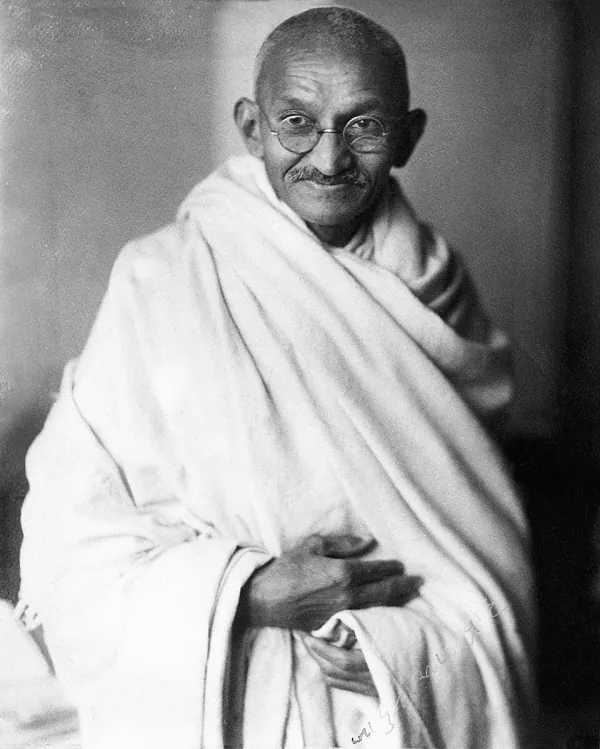
He developed satyagraha, ‘holding firmly to truth’: resisting injustice through non-violent non-cooperation and willingly accepted suffering, on the conviction that means shape ends and that truth is God.
Life and thought
Mohandas Karamchand Gandhi (1869–1948) grew up in Gujarat in a devout Vaiṣṇava family in a region with a strong Jain presence, trained as a barrister in London, and spent twenty-one years in South Africa, where racial discrimination turned a shy lawyer into an organiser of mass resistance. Back in India from 1915, he led the national movement through campaigns such as the Salt March of 1930. He was assassinated by a Hindu nationalist in January 1948, months after independence.
Gandhi’s philosophy was worked out in action. Satyagraha, “holding fast to truth”, is resistance that refuses both submission and violence: the resister breaks an unjust law openly, accepts the penalty, and seeks to convert the opponent rather than defeat him. Behind it lie the convictions that means and ends cannot be separated, that truth is God, and that self-rule (swaraj) begins with ruling oneself. In Hind Swaraj (1909) he turned this into a critique of modern industrial civilisation. Ambedkar fought him over caste; Martin Luther King Jr. adopted his method.
Works
Shaped by
traditionally 599–527 BCE (many scholars: c. 499–425 BCE)MahāvīraGandhi’s commitment to non-violence drew on Gujarat’s Jain culture, especially his Jain friend and mentor Raychandbhai.Criticised by
1891–1956B. R. AmbedkarThey clashed over separate electorates for Dalits in 1932 and over whether caste could be reformed from within Hinduism.Meanwhile, in other traditions
1857–1913Ferdinand de SaussureGeneva linguist whose lectures founded structural linguistics1859–1938Edmund HusserlMoravian-born mathematician turned philosopher, founder of phenomenology1859–1952John DeweyPhilosopher of education and democracy; lectured in China 1919–211870–1945Nishida KitarōFounder of the Kyoto School1872–1970Bertrand RussellLogician, public intellectual and Nobel laureate; lectured in China 1920–211873–1958G. E. MooreCambridge defender of common sense against idealismOn the record
Gandhi’s non-violence drew on Gujarat’s Jain culture, especially his Jain friend and mentor Raychandbhai.
Gandhi’s Autobiography devotes a chapter to Raychandbhai (Shrimad Rajchandra), the Jain poet and thinker he met on landing in Bombay in 1891. He names him first among ‘three moderns’ who left a deep impress on his life, with Tolstoy and Ruskin, and calls him his refuge in moments of spiritual crisis, though not his guru.
Sources: M. K. Gandhi, An Autobiography, Part II, ch. 1, “Raychandbhai”