Analytic & pragmatist · 1839–1914
Charles Sanders Peirce
Logician and scientist who founded pragmatism and semiotics
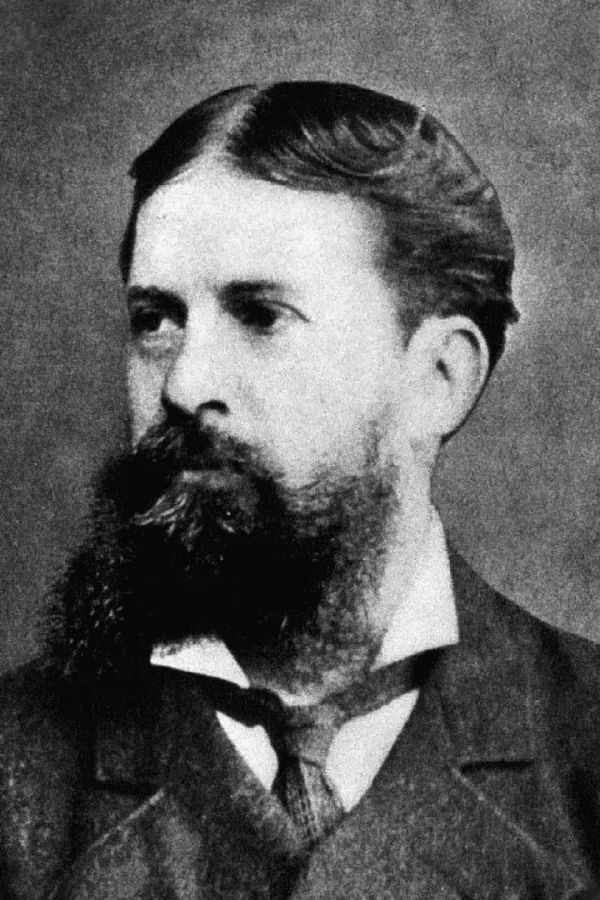
To make an idea clear, ask what practical effects its object could conceivably have; truth is the opinion that endless inquiry by a community of investigators would finally agree on.
Life and thought
Charles Sanders Peirce (1839–1914) grew up in Cambridge, Massachusetts, the son of the Harvard mathematician Benjamin Peirce, and trained as a chemist. For about three decades he worked for the US Coast Survey, measuring gravity with pendulums, while writing on logic. He taught logic at Johns Hopkins from 1879 to 1884, lost the post, and never held another academic job; he died poor in Milford, Pennsylvania, leaving a vast mass of unpublished manuscripts.
In “How to Make Our Ideas Clear” (1878) he proposed a test for meaning: our idea of a thing is our idea of its practical effects. To call something “hard” is to say that many other things will not scratch it. Truth is what an unending community of inquirers would finally agree on, and inquiry starts from real doubt, not Descartes’ pretended doubt. He also founded a general theory of signs and, independently of Frege, a logic of quantifiers. When William James made “pragmatism” famous, Peirce renamed his own version “pragmaticism” to keep it apart.
Works
Shaped by
1724–1804Immanuel KantFrom 1855, his first year at Harvard, Peirce spent about three years in intense study of the Critique of Pure Reason, and kept rereading it all his life.c. 1266–1308John Duns ScotusPeirce called himself a scholastic realist “of a somewhat extreme stripe”, close to Scotus.Shaped
1842–1910William JamesIn 1898 James publicly credited his friend Peirce with the principle of pragmatism.1859–1952John DeweyDewey took Peirce’s logic course as a graduate student at Johns Hopkins, and later built on his theory of inquiry.Meanwhile, in other traditions
1818–1883Karl MarxGerman philosopher, economist and revolutionary in London exile1820–1895Friedrich EngelsManufacturer’s son who co-founded Marxism with Marx1833–1911Wilhelm DiltheyGerman historian of ideas who defended the human sciences1844–1900Friedrich NietzscheGerman philologist who diagnosed the death of God1857–1913Ferdinand de SaussureGeneva linguist whose lectures founded structural linguistics1859–1938Edmund HusserlMoravian-born mathematician turned philosopher, founder of phenomenologyOn the record
The note said Peirce studied the Critique of Pure Reason for hours every day for more than three years.
The Stanford Encyclopedia confirms that Peirce began Kant in 1855, his first year at Harvard, spent about three years in intense study of the Critique, and kept rereading it all his life, though he came to judge its logic flawed. The exact daily-hours wording could not be checked in a source, so the note now states what is documented.
Sources: Stanford Encyclopedia of Philosophy, “Charles Sanders Peirce”
Dewey took Peirce’s logic course at Johns Hopkins; the atlas records this as influence rather than teaching.
As a graduate student at Johns Hopkins (1882–84) Dewey studied logic with Peirce but found it “too mathematical” and did not pursue it; Peirce had no sizable impact on him then, though Dewey later credited Peirce’s pragmatism as an important influence. “Influenced” is the right kind of tie.