Dialectica Open the atlas

Continental · 1818–1883

Karl Marx

German philosopher, economist and revolutionary in London exile
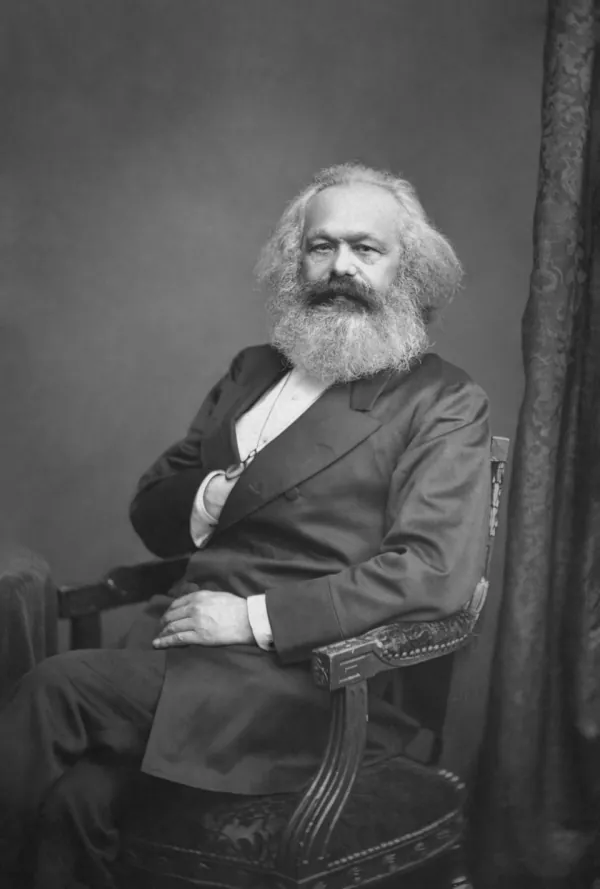
Karl Marx
John Jabez Edwin Mayall · Public domain · Commons ↗

Marx turned Hegel’s dialectic into historical materialism: the way a society produces its means of life shapes its politics and ideas, and capitalism’s class conflict points beyond it.

Life and thought

Karl Marx (1818–1883) was born in Trier, studied law and philosophy in Bonn and Berlin, where he joined the Young Hegelians, and became a radical journalist. Expelled from Paris, Brussels and Cologne in turn, he settled in London in 1849 and spent decades in the British Museum reading room, supported largely by Friedrich Engels, while living through poverty and the deaths of several of his children.

Marx kept Hegel’s idea that history moves through conflict but grounded it in material life: how people produce food, clothing and shelter, and who owns the means of production, shapes law, politics and ideas. In Capital he argued that profit comes from surplus value: workers sell their labour-power for a wage but produce more value than the wage, and the owner keeps the difference. Competition and crises, he predicted, would push capitalism towards its own overthrow. His work inspired socialist movements, revolutions and whole schools of social theory.

Works

1844Economic and Philosophic Manuscripts of 1844
1848The Communist Manifesto (with Engels)
1867Capital, Volume I

Shaped by

1770–1831Georg Wilhelm Friedrich HegelMarx kept Hegel’s dialectic but replaced the movement of Spirit with material production.341–270 BCEEpicurusMarx wrote his doctoral dissertation (1841) on the natural philosophy of Democritus and Epicurus.1723–1790Adam SmithMarx took the labour theory of value from Smith and Ricardo and turned it into a critique of capitalism.1820–1895Friedrich EngelsLifelong collaborators; Engels’s study of Manchester workers shaped Marx’s picture of industrial capitalism.

Shaped

1820–1895Friedrich EngelsAfter Marx’s death Engels edited volumes II and III of Capital.1891–1937Antonio GramsciItalian communist leader who wrote his major work in Mussolini’s prisons1905–1980Jean-Paul SartreIn Critique of Dialectical Reason (1960) he tried to join existentialism and Marxism.1895–1973Max HorkheimerDirector of the Frankfurt Institute who defined critical theory1892–1940Walter BenjaminBerlin critic who joined Marxism, messianism and media theory1898–1979Herbert MarcuseFrankfurt School exile who became the New Left’s philosopherborn 1942Gayatri Chakravorty SpivakIndian-born theorist and translator of Derrida, at Columbia University1929–2025Alasdair MacIntyreScottish-born philosopher who moved from Marxism to Thomism

Criticised by

1902–1994Karl PopperViennese-born philosopher of science and defender of the open society1891–1956B. R. AmbedkarIn ‘Buddha or Karl Marx’ he argued that the Buddha’s path reaches Marx’s goals of equality without violence or dictatorship.

Meanwhile, in other traditions

1788–1860Arthur SchopenhauerGerman pessimist who saw a blind will behind all things1806–1873John Stuart MillEnglish philosopher of liberty, utility and women’s equality1839–1914Charles Sanders PeirceLogician and scientist who founded pragmatism and semiotics1842–1910William JamesPsychologist and philosopher who made pragmatism famous1848–1925Gottlob FregeJena mathematician who invented modern logic1859–1952John DeweyPhilosopher of education and democracy; lectured in China 1919–21