Dialectica Open the atlas

Analytic & pragmatist · 1848–1925

Gottlob Frege

Jena mathematician who invented modern logic
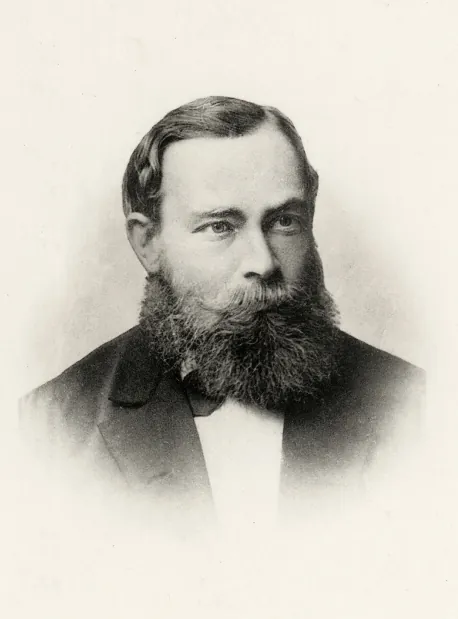
Gottlob Frege
Unknown author · Public domain · Commons ↗

Arithmetic can be derived from logic, and expressions have both a sense (a way of presenting something) and a reference (the thing itself): “the morning star” and “the evening star” differ in sense but both refer to Venus.

Life and thought

Gottlob Frege (1848–1925) spent his whole career teaching mathematics at the University of Jena and was little noticed in his lifetime. In the Begriffsschrift (1879), a short book in an unusual two-dimensional notation, he created the first modern logic of quantifiers and variables, the system every logic student now learns in other symbols. His aim was to show that arithmetic is nothing but logic. In 1902, as the second volume of his Basic Laws of Arithmetic went to press, Russell wrote to him that one of his axioms led to a contradiction; Frege added an appendix admitting that his foundations had been shaken.

In “On Sense and Reference” (1892) he asked how “the morning star is the evening star” can tell us something, when both names refer to the same planet, Venus. His answer: an expression has a reference, the object it picks out, and a sense, the way it presents that object. The two names share a reference but differ in sense, so the sentence is informative. Philosophy of language, and much of analytic philosophy, starts from this distinction.

Works

1879Begriffsschrift
1884The Foundations of Arithmetic
1892On Sense and Reference

Shaped by

1646–1716Gottfried Wilhelm LeibnizGerman polymath, co-inventor of calculus, theorist of monads

Students

1891–1970Rudolf CarnapCarnap attended Frege’s logic lectures at Jena before the First World War.

Shaped

1872–1970Bertrand RussellIn 1902 Russell wrote to Frege about the paradox that broke Frege’s system, while adopting much of his logic.1889–1951Ludwig WittgensteinWittgenstein visited Frege in Jena, and it was Frege who advised him to go to Russell.

Argued against

1724–1804Immanuel KantFrege argued, against Kant, that arithmetic is analytic, though he agreed with Kant that geometry is synthetic a priori.1806–1873John Stuart MillThe Foundations of Arithmetic mocks Mill’s empiricist view of number as “gingerbread and pebble arithmetic”.

Meanwhile, in other traditions

1833–1911Wilhelm DiltheyGerman historian of ideas who defended the human sciences1844–1900Friedrich NietzscheGerman philologist who diagnosed the death of God1857–1913Ferdinand de SaussureGeneva linguist whose lectures founded structural linguistics1859–1938Edmund HusserlMoravian-born mathematician turned philosopher, founder of phenomenology1863–1902Swami VivekanandaMonk who introduced Vedānta and yoga to the West1869–1948Mohandas K. GandhiLeader of Indian independence and theorist of non-violent resistance