Early modern Europe · 1646–1716
Gottfried Wilhelm Leibniz
German polymath, co-inventor of calculus, theorist of monads
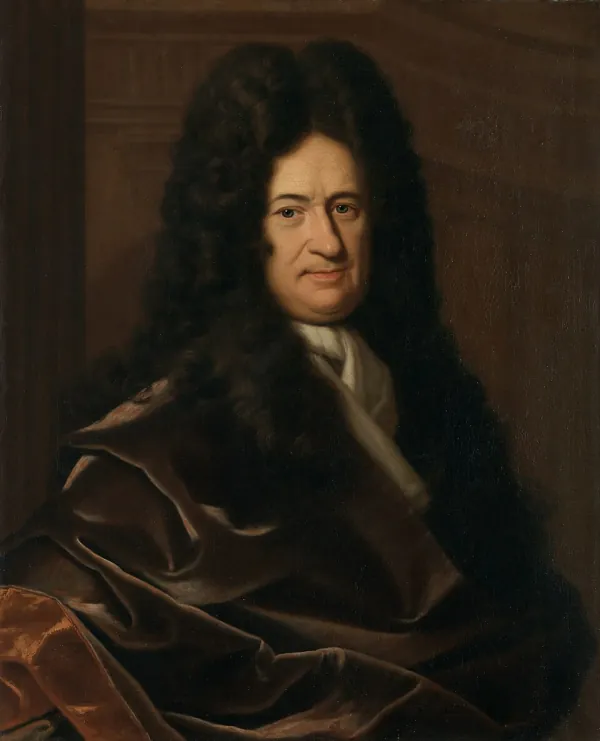
The world consists of simple, mind-like substances, monads, whose states God harmonised in advance. Because God chose by the principle of sufficient reason, this is the best of all possible worlds — the claim Voltaire mocked in Candide.
Life and thought
Gottfried Wilhelm Leibniz was born in Leipzig and took a doctorate in law at twenty. He spent his life in the service of courts, above all as librarian, historian and counsellor to the House of Hanover. During a stay in Paris in 1672–76 he invented the calculus independently of Newton, which led to a bitter dispute over priority; he also built a calculating machine and founded the Berlin Academy of Sciences. Most of his philosophy lies in letters and short essays rather than a single great book.
Leibniz builds on two principles: contradiction, and sufficient reason — nothing happens without a reason why it is so and not otherwise. The true units of the world are monads: simple substances without parts, each perceiving the whole universe from its own point of view. Monads do not act on one another; God set them in a “pre-established harmony”, like clocks that keep the same time. Because God chose among infinitely many possible worlds, he chose the best, so the evil in it is part of the greatest overall good. Voltaire mocked this in Candide; Kant was trained in the school it founded.