Early modern Europe · 1632–1677
Baruch Spinoza
Dutch lens-grinder, expelled by his synagogue, who equated God with Nature
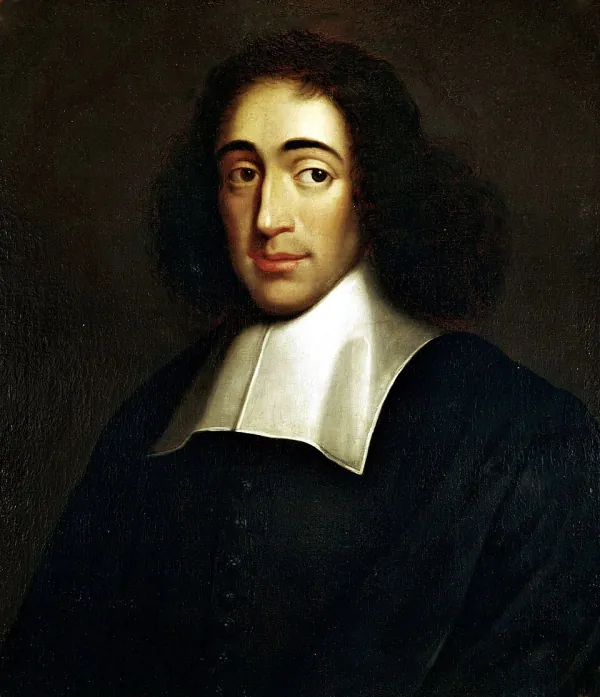
There is only one substance, “God or Nature”, and everything follows from it with necessity; mind and body are two aspects of one thing. Freedom is not escape from necessity but understanding it, which releases us from bondage to the passions.
Life and thought
Baruch (Benedictus) de Spinoza was born in Amsterdam to a family of Portuguese Jewish merchants. In 1656 the city’s synagogue issued a herem, a writ of expulsion, against him for “abominable heresies”. He lived modestly, grinding lenses for microscopes and telescopes, corresponded with scientists, and turned down a professorship at Heidelberg to keep his freedom. His Theological-Political Treatise came out anonymously in 1670 and was widely banned; his Ethics appeared only after his death in 1677.
The Ethics is set out like geometry, with definitions, axioms and proofs. Its conclusion is that there is only one substance, infinite and the cause of itself — “God or Nature” — and that minds and bodies are its finite modes, one and the same thing seen under thought or under extension. Everything follows necessarily; nature has no purposes and we have no free will in the usual sense. Freedom means understanding the causes of our emotions, which turns passive passions into active joy. Branded an atheist for a century, he was rediscovered by the German idealists, and Novalis called him a “God-intoxicated man”.