Dialectica Open the atlas

The Islamic world · 980–1037

Ibn Sīnā (Avicenna)

Persian physician-philosopher, the most influential Islamic philosopher
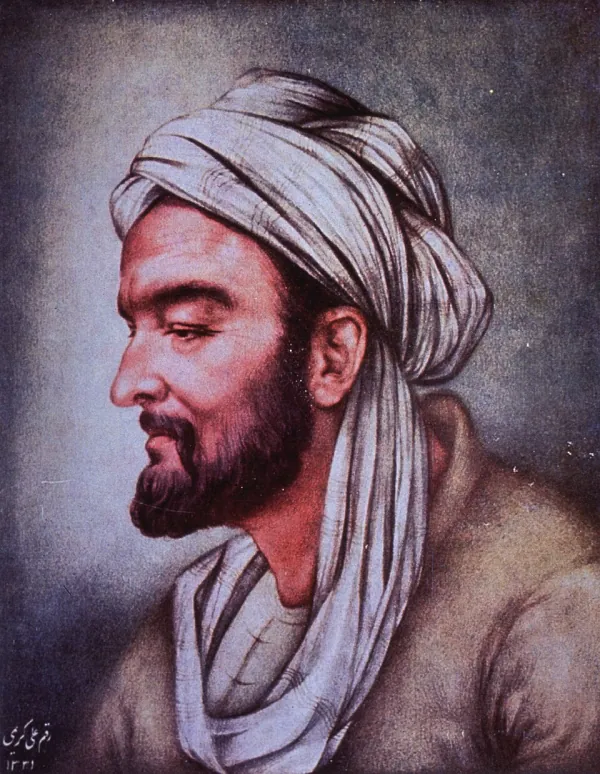
Ibn Sīnā (Avicenna)
National Library of Medicine · No restrictions · Commons ↗

Essence and existence are distinct: knowing what a thing is does not tell you that it is, so all contingent things need a Necessary Existent. His “floating man”, suspended without any sensation, still knows that he exists.

Life and thought

Ibn Sīnā, known in Latin as Avicenna, was born in 980 near Bukhara, in Central Asia. A prodigy, he had mastered medicine by his late teens and was rewarded with the run of the Samanid royal library. When that dynasty fell he moved from court to court across Iran, serving as physician and sometimes vizier, writing at night and on campaigns, and once in prison. He died in Hamadan in 1037.

His Canon of Medicine was taught in Europe for five centuries, and his Book of Healing was an encyclopedia of philosophy. Its central idea is the distinction between essence and existence: you can understand what a triangle or a horse is without knowing whether any exists, so existence is not part of a thing’s essence. Everything whose existence is merely possible must get it from something else, and the chain must end in a Necessary Existent, whose essence is to exist: God. His “floating man”, created in mid-air with no sensations, would still know that he exists, so the soul knows itself directly.

Works

c. 1025The Canon of Medicine
c. 1027The Book of Healing (al-Shifāʾ)
c. 1030Pointers and Reminders

Shaped by

c. 870–950Al-FārābīAvicenna wrote that he read Aristotle’s Metaphysics forty times without understanding it until he found al-Fārābī’s short treatise on it.384–322 BCEAristotlePlato’s student, Alexander’s tutor, founder of the Lyceum

Shaped

1225–1274Thomas AquinasDominican friar who wove Aristotle into Christian theologyc. 1266–1308John Duns ScotusFranciscan theologian, the “Subtle Doctor”1138–1204Maimonides (Moses ben Maimon)Rabbi, physician and philosopher from Córdoba, later in Cairoc. 1105–1185Ibn ṬufaylIbn Ṭufayl borrowed the name Ḥayy ibn Yaqẓān from an allegory by Avicenna.c. 1571–1636Mullā ṢadrāSafavid philosopher of Shiraz, founder of Transcendent Theosophy

Criticised by

1126–1198Ibn Rushd (Averroes)Averroes faulted Avicenna for compromising Aristotle with theology, for example in treating existence as an accident of essence.c. 1058–1111Al-GhazālīThe Incoherence of the Philosophers targets Avicenna’s eternal world, God’s knowledge of particulars and necessary causation.1154–1191Shihāb al-Dīn SuhrawardīSuhrawardī began in Avicenna’s school, then argued that Peripatetic definitions can never reveal a thing’s essence.1332–1406Ibn KhaldūnThe Muqaddimah includes a “refutation of philosophy” aimed at al-Fārābī and Avicenna’s claim to know metaphysical truth by reason.

Meanwhile, in other traditions

1017–1073Zhou DunyiSong scholar honoured as the pioneer of Neo-Confucianism1020–1077Zhang ZaiNeo-Confucian who saw all things as condensations of qi1032–1085Cheng HaoElder Cheng brother, teacher of humaneness as oneness1033–1107Cheng YiYounger Cheng brother who made “principle” central1033–1109Anselm of CanterburyBenedictine monk and Archbishop of Canterbury