The Islamic world · c. 870–950
Al-Fārābī
Logician called the “Second Teacher” after Aristotle
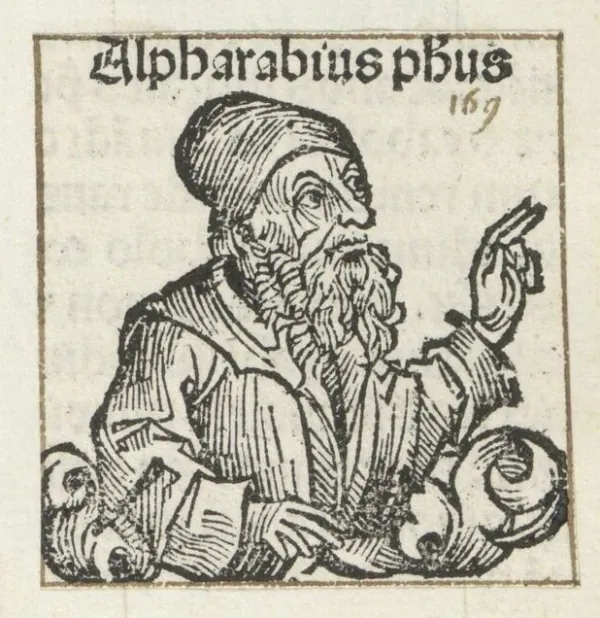
The ideal city is ruled by a philosopher-prophet who grasps the truth by reason and conveys it to the people in images; religion is philosophy expressed in symbols.
Life and thought
Abū Naṣr al-Fārābī was born around 870, probably in Fārāb in Central Asia, though whether his family was Turkic or Persian is disputed. He studied logic in Baghdad with Christian scholars of the Aristotelian school, lived there for decades, and spent his last years in Aleppo and Damascus, where he died in 950 or 951. Later tradition called him the “Second Teacher”, after Aristotle.
He set out to rebuild the whole of philosophy in Arabic: logic as the grammar of all languages, a classification of the sciences, and a cosmology in which intellects emanate from the First Cause down to the active intellect that lights up human minds. His Virtuous City joins this to Plato’s Republic. A city is virtuous when it aims at true happiness, and its ruler must be a philosopher who also has the prophet’s gift of turning truths into images and laws that ordinary people can follow. Religion, on this view, is philosophy in symbolic form. Avicenna said he understood Aristotle’s Metaphysics only through al-Fārābī.