Greece & Rome · c. 428–348 BCE
Plato
Socrates’ student, founder of the Academy, master of the dialogue
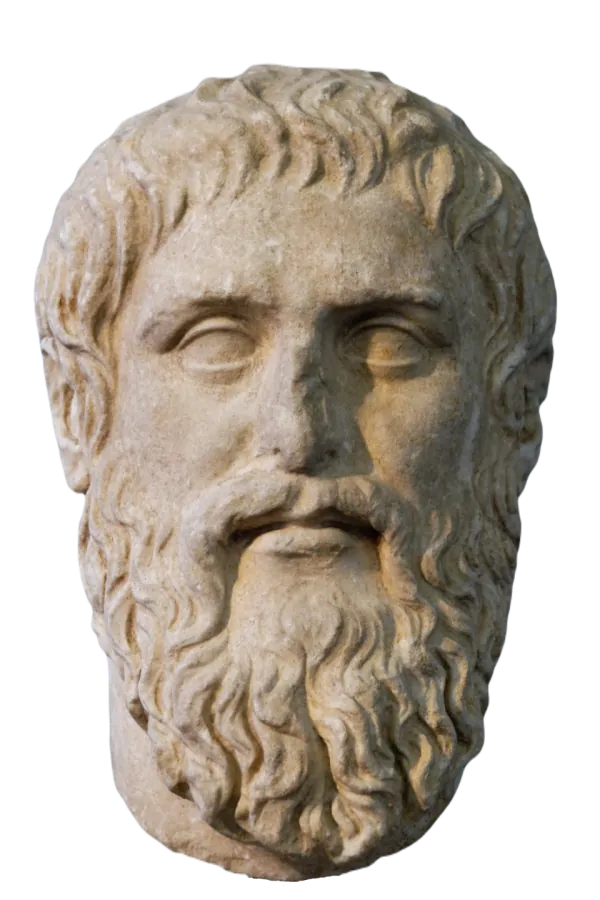
Argued that true knowledge is of eternal Forms, above all the Form of the Good, and that a just soul and a just city both need reason to rule. He wrote dialogues, so his own views must be read through his characters.
Life and thought
Plato was born into an aristocratic Athenian family around 428 BCE and grew up during the Peloponnesian War. He expected a political career, but the oligarchy of 404, which included his relatives, and then the execution of Socrates in 399 turned him away from Athenian politics. After travels that took him to Sicily, he founded the Academy around 387, where Aristotle studied for twenty years. All his known works survive, nearly all as dialogues in which he himself never speaks.
His central idea is that the things we see are unstable copies, and that knowledge is of something stable: Forms, such as Justice itself or Equality itself, grasped by reason rather than the senses. The Republic’s cave image shows people mistaking shadows for reality, and the philosopher as the one who turns around. The soul, akin to the Forms, is immortal, and a just person is one whose reason rules spirit and appetite; a just city mirrors that order. Nearly every later philosophy has defined itself for or against Plato.
Works
Teachers
c. 470–399 BCESocratesAthenian questioner, executed for impiety in 399 BCEShaped by
c. 535–475 BCEHeraclitusAristotle says Plato learned the Heraclitean view that sensible things are in flux from Cratylus.c. 570–495 BCEPythagorasFounder of a philosophical and religious brotherhood at Crotonc. 515 – after 450 BCEParmenidesFounder of the Eleatic school and of deductive argumentStudents
384–322 BCEAristotlePlato’s student, Alexander’s tutor, founder of the LyceumShaped
106–43 BCECiceroRoman orator and statesman who brought Greek philosophy into Latinc. 204–270PlotinusFounder of Neoplatonism, teaching in Rome412–485ProclusHead of the Platonic school in Athens and Neoplatonism’s great systematiserc. 870–950Al-FārābīLogician called the “Second Teacher” after Aristotle1154–1191Shihāb al-Dīn SuhrawardīPersian founder of Illuminationism, executed in Aleppo1463–1494Giovanni Pico della MirandolaItalian humanist who proclaimed humanity’s freedom to shape itself1788–1860Arthur SchopenhauerGerman pessimist who saw a blind will behind all things1768–1834Friedrich SchleiermacherHis German translation of Plato remained standard for generations.1900–2002Hans-Georg GadamerHeidegger’s student, who made hermeneutics a philosophy of understandingArgued against
c. 490–420 BCEProtagorasPlato’s Theaetetus argues that “man is the measure” refutes itself.c. 483–375 BCEGorgiasPlato’s Gorgias contrasts rhetoric that flatters with philosophy that seeks the good.Criticised by
1902–1994Karl PopperThe Open Society and Its Enemies attacks Plato, Hegel and Marx as forerunners of closed, totalitarian societies.Meanwhile, in other traditions
c. 480–400 BCE (debated; an older dating is c. 563–483 BCE)The Buddha (Siddhārtha Gautama)Founder of Buddhism, who taught a middle way out of sufferingc. 470–391 BCEMoziFounder of Mohism and critic of Confucian partialityc. 390–338 BCEShang YangQin minister whose reforms built Qin’s powerc. 372–289 BCEMenciusConfucian who argued that human nature is goodc. 370–310 BCEHui ShiWei statesman, logician and Zhuangzi’s debating partnerc. 369–286 BCEZhuangziDaoist writer of parables, paradoxes and freedomOn the record
The years given for Plato’s dialogues (Symposium c. 385, Phaedo c. 380, Republic c. 375 BCE) are approximate.
No dialogue is securely dated. The usual early, middle and late grouping rests on ancient testimony that the Laws came last and on stylometric study of the Greek; it remains disputed whether it reflects the order of composition. The atlas’s years follow the common view that the Symposium, Phaedo and Republic belong to the middle period.