Greece & Rome · c. 470–399 BCE
Socrates
Athenian questioner, executed for impiety in 399 BCE
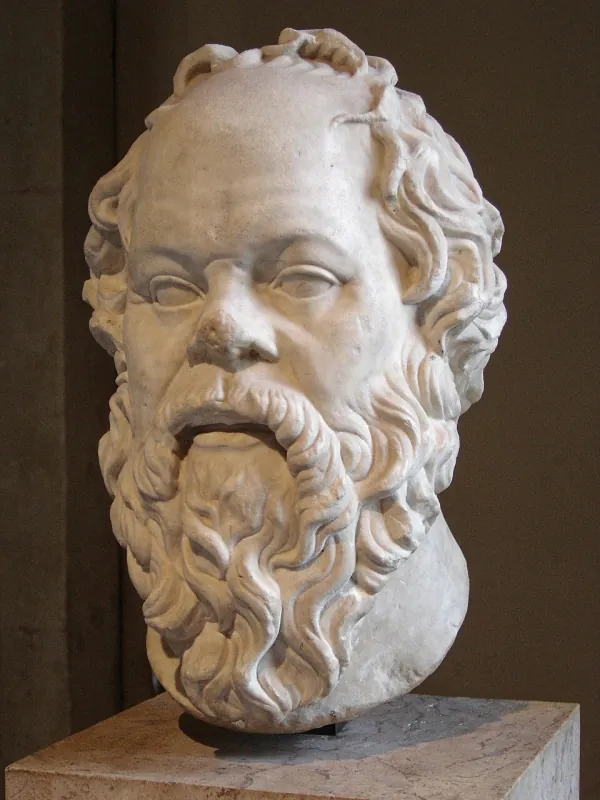
Claimed only to know that he knew nothing, and spent his life questioning Athenians about justice, courage and the good. He wrote nothing; his thought reaches us mainly through Plato’s dialogues, so the historical Socrates is hard to separate from Plato’s character.
Life and thought
Socrates spent almost his whole life in Athens, the son of a stonemason and a midwife. He fought as a hoplite in the Peloponnesian War, held no regular job and spent his days questioning people in the marketplace. He wrote nothing: we know him through Plato’s dialogues, Xenophon’s memoirs and Aristophanes’ comic portrait, which disagree, so the historical Socrates is partly a reconstruction. In 399 BCE, after Athens’ defeat and a period of oligarchic terror involving some of his former associates, he was tried for impiety and corrupting the young and executed with hemlock.
His method was the elenchus: ask someone what courage or justice is, then show that their answer conflicts with other things they believe. The point was not to win but to expose false confidence. Behind it lay convictions: that virtue is a kind of knowledge, that no one does wrong willingly, and, as Plato’s Apology has him say, that the unexamined life is not worth living. Nearly every later Greek school claimed him as its ancestor.