China & East Asia · traditionally 6th c. BCE
Laozi
Legendary sage credited with the Daodejing
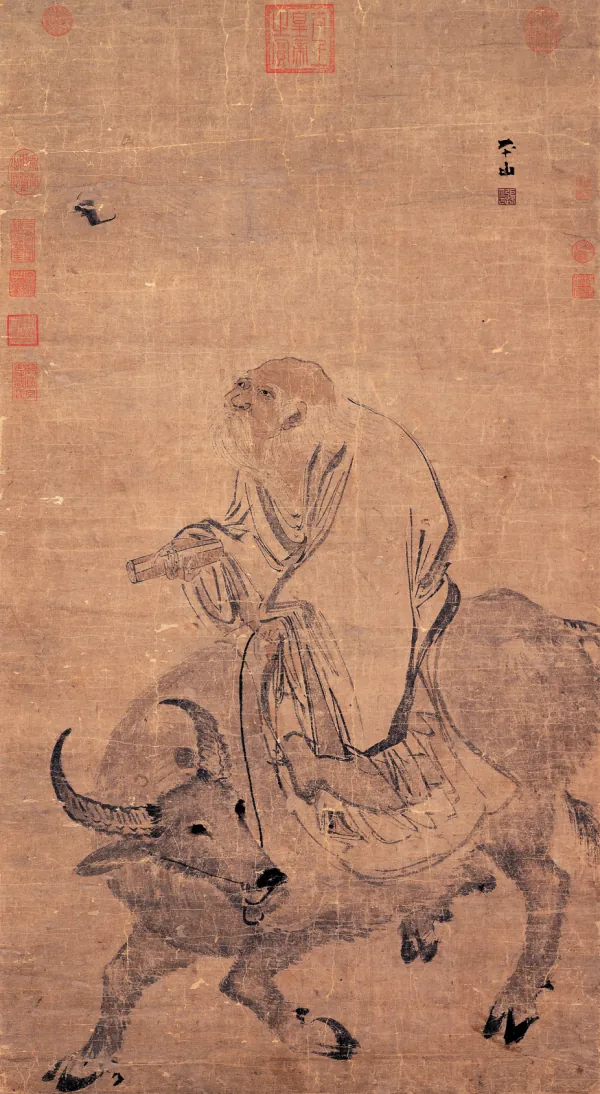
The Daodejing teaches that the Dao is nameless and acts by not acting, and that the sage ruler stays low like water and lets things take their course. Whether a single author named Laozi existed is doubted; the text was probably written down from the late 5th century BCE and was fairly stable by the mid-3rd.
Life and thought
According to Sima Qian’s Records of the Grand Historian (c. 100 BCE), Laozi, “the Old Master”, was Li Er, a keeper of archives at the Zhou court whom Confucius once consulted on ritual; weary of the declining dynasty, he left for the west and, at a border pass, wrote a book of five thousand characters. Sima Qian himself records rival identifications, and many modern scholars treat Laozi as a legend that gathered several figures. Bamboo slips from a Guodian tomb of about 300 BCE hold the oldest known parts of the text.
The Daodejing’s 81 short chapters argue that the Dao, the way all things come about, cannot be captured in names. Its favourite image is water: soft and low, yet it wears away stone. Striving, display and multiplying rules breed their opposites, so the sage ruler “acts without acting” (wuwei), keeps desires few and lets the people settle themselves. Read as political advice, spiritual guidance and cosmology, it became the founding text of Daoism, shaped Legalists such as Han Fei, and is among the most translated books in the world.
Works
Shaped
c. 369–286 BCEZhuangziTraditionally paired as “Lao–Zhuang”, though which text came first is debated.c. 280–233 BCEHan FeiziPrince of Han who synthesised Legalist thought226–249Wang BiProdigy commentator who founded Xuanxue metaphysicsMeanwhile, in other traditions
c. 610–546 BCEAnaximanderThales’ successor, credited with the first Greek world maptraditionally 599–527 BCE (many scholars: c. 499–425 BCE)MahāvīraTwenty-fourth Jain tīrthaṅkara, a contemporary of the Buddhac. 586–526 BCEAnaximenesThird Milesian, who made air the first principlec. 570–495 BCEPythagorasFounder of a philosophical and religious brotherhood at Crotonfl. 6th–5th c. BCEAjita KesakambalīMaterialist teacher of the Buddha’s time, named for his hair blanketc. 535–475 BCEHeraclitusRiddling sage of Ephesus who saw the world as ordered fluxOn the record
Laozi is dated “traditionally 6th c. BCE”, and the Daodejing is said to have grown over the 4th–3rd centuries BCE.
Chinese tradition, following Sima Qian, makes Laozi a senior contemporary of Confucius in the 6th century BCE, but some modern scholars think he is entirely legendary and that his story conflates several figures. Sayings were probably written down from the late 5th century and consolidated in the 4th; bamboo slips from a Guodian tomb of about 300 BCE hold the oldest known parts of the text, which was fairly stable by the mid-3rd century. The years used to place him on the map are placeholders.