India · c. 150–250
Nāgārjuna
Founder of Madhyamaka, revered as a ‘second Buddha’
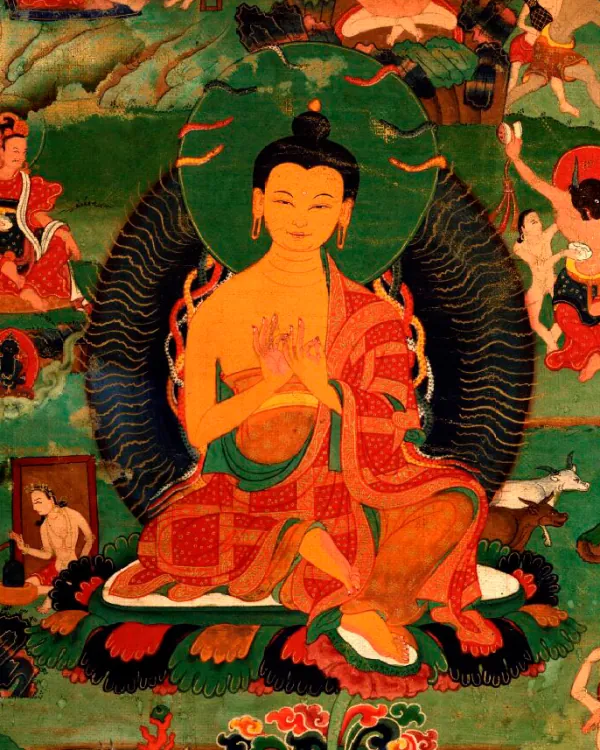
He argued that nothing has intrinsic nature because everything arises dependently; emptiness is not nothingness but the Middle Way, and emptiness itself is empty.
Life and thought
Nāgārjuna, active around 150–250 CE in southern India, is the most important Buddhist philosopher after the Buddha himself; Tibetan and East Asian traditions call him a “second Buddha”. Legend says he brought the Perfection of Wisdom scriptures back from the realm of the serpent-spirits (nāgas). Historically, little is certain beyond his writings, which include the Fundamental Verses on the Middle Way and letters of advice traditionally addressed to a Sātavāhana king.
His method is to take any concept that claims to name something with its own nature (svabhāva)—cause, motion, time, the self, even the Buddha—and show that it collapses into contradiction. If a cause had its own nature, it would need nothing else to produce its effect; if an effect already had one, it would not need producing. Since everything arises dependently, nothing has intrinsic nature: this is emptiness (śūnyatā). Emptiness is not nothingness but the middle way between eternalism and nihilism, and it is itself empty. Madhyamaka, Tibetan scholasticism and Chan and Zen all build on him.