China & East Asia · 551–479 BCE (traditional)
Confucius
Teacher from Lu who sought to revive the Zhou way
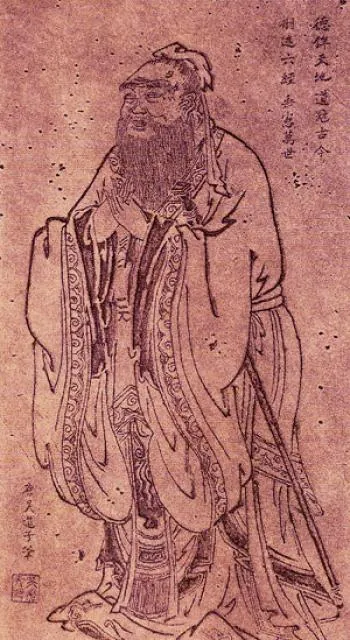
Taught that anyone can become an exemplary person (junzi) by cultivating humaneness and practising ritual, beginning with respect within the family. He wrote no treatise; his sayings were collected by his disciples’ circles in the Analects.
Life and thought
Kong Qiu, later honoured as Kongzi or Master Kong, was born in the small state of Lu, traditionally in 551 BCE, to a family of minor gentry; his father died when he was a child. He worked as a keeper of granaries and herds, rose to office in Lu, and then spent about fourteen years travelling between states in search of a ruler who would put his ideas into practice. None did. He returned home to teach, and his disciples, drawn from every rank, carried his sayings on.
He lived as the Zhou order was falling apart, and he believed it could be restored not by force but by character. The key is ren, humaneness, summed up in the rule “do not impose on others what you yourself do not desire”, and li, the rituals and courtesies that train feeling into right conduct, beginning with respect for parents. An exemplary person (junzi) is made by virtue, not birth, and a ruler who governs by virtue draws people as the stars turn around the Pole Star. The Analects, compiled by later disciples, became the core of Chinese education until 1905.