India · c. 700–750 (older scholarship: 788–820)
Śaṅkara
Advaita master whose commentaries defined non-dual Vedānta
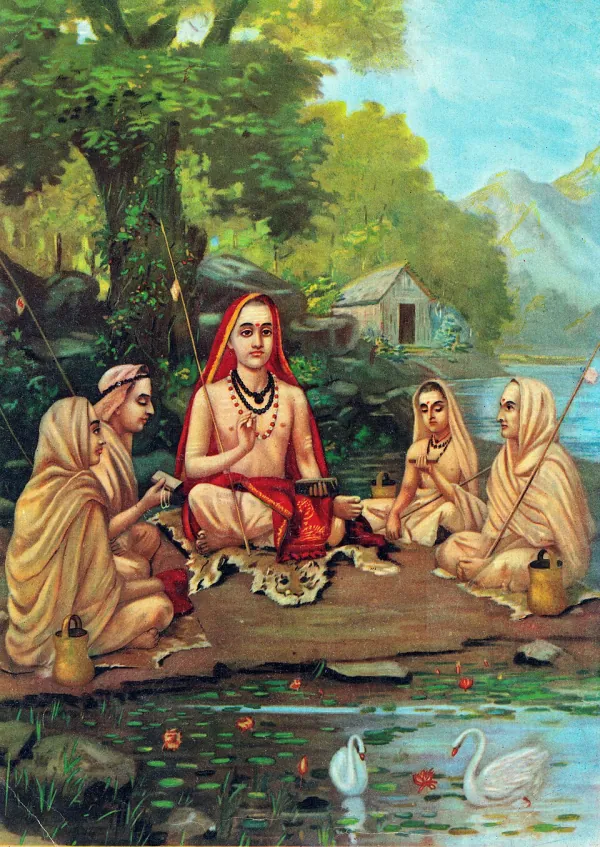
He taught that Brahman, pure consciousness, alone is real, that the individual self is identical with it, and that the world is superimposed on it through ignorance; liberation comes from knowledge, not ritual.
Life and thought
Śaṅkara, usually dated to the early 8th century, is the most celebrated teacher of Advaita (“non-dual”) Vedānta. Nothing reliable is known of his life beyond his works: traditional biographies written centuries later tell of a Kerala-born renouncer who studied with Govinda, debated across India, founded monasteries and died young. His certain works are commentaries on the Brahma Sūtra, the major Upanishads and the Bhagavad Gītā, and the Thousand Teachings.
Śaṅkara reads the Upanishads as teaching one thing: Brahman, pure consciousness, alone is real, and your innermost self is not a part of it but identical with it. Why then do we experience many separate things and selves? Because ignorance (avidyā) superimposes the world on Brahman, as in the dark we see a snake where there is a rope. The world is not nothing—it is real for practical purposes—but it is not ultimately real. Ritual and good works purify the mind, but only knowledge removes ignorance and liberates. Rāmānuja and Madhva built their systems against him.
Works
Shaped by
c. 6th c. CEGauḍapādaBy tradition Gauḍapāda taught Govinda, who taught Śaṅkara.fl. c. 8th–7th c. BCE (traditional)YājñavalkyaSage who wins the great debate at King Janaka’s courtfl. c. 8th c. BCE (traditional)Uddālaka ĀruṇiUddālaka’s ‘tat tvam asi’ became one of Advaita’s ‘great sayings’ (mahāvākyas).Shaped
1863–1902Swami VivekanandaMonk who introduced Vedānta and yoga to the WestArgued against
fl. c. 660Kumārila BhaṭṭaŚaṅkara borrowed much Mīmāṃsā method but rejected its claim that ritual action is the path to the highest good.Criticised by
c. 1077–1157 (traditionally 1017–1137)RāmānujaRāmānuja’s commentary is a sustained critique of Śaṅkara’s illusory world and featureless Brahman.1238–1317 (some sources: 1199–1278)MadhvaMadhva wrote against Advaita at length, insisting on the real difference between God and souls.Meanwhile, in other traditions
638–713HuinengSixth Patriarch of Chan, emblem of sudden awakeningOn the record
Śaṅkara lived c. 700–750; traditionally 788–820.
788–820 is not the tradition’s date but the one early modern scholars proposed. The Stanford Encyclopedia reports that Nakamura argues at length for 700–750 and Potter for the late 7th to early 8th century, and that nothing is reliably known of his life beyond his works. Advaita monastic traditions give dates far earlier still.